
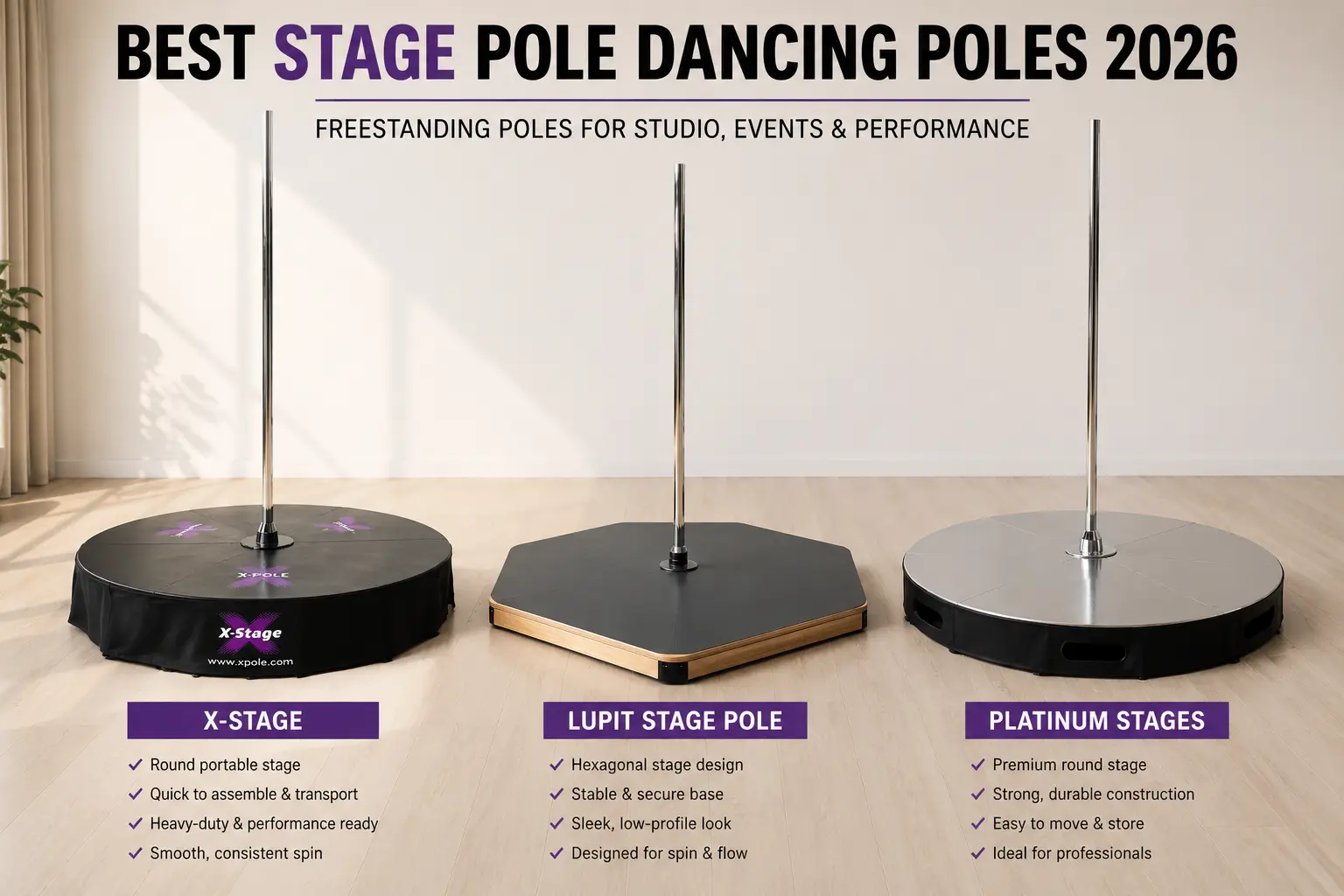
A freestanding stage pole opens up spaces that a tension pole cannot: venues with concrete ceilings, outdoor performances, mobile workshops, and studios where drilling or ceiling contact is off the table. A quality stage gives you a stable, competition-grade pole anywhere you set it up, without compromising on diameter, finish or switching ability.
We have researched every major stage pole on the market, comparing specifications, real-world user feedback, pricing, and parts availability in the UK. We looked at how each stage assembles and disassembles, how it performs underfoot during floorwork, and how practical it is to transport repeatedly. Whether you need a stage for a permanent studio, weekend workshops, or touring performances, we have found a strong option for each use case.
For most studio owners and performers, we keep coming back to the X-Pole X-Stage Lite. The combination of a wide finish range, solid UK parts support, and a sensible price makes it the most practical all-round choice. If you move your equipment regularly, the Lupit Pole Stage is worth the premium: its composite panels are noticeably lighter and quieter underfoot than the X-Stage’s metal ones, and the Quick Lock system lets you flip between spin and static without stopping. For the lightest setup available and a beautifully warm wooden base surface, the ThePole Pole Hive Evo is the one we reach for first when floor comfort and minimum carry weight both matter.
Related: Best Pole Dancing Pole for Home Use – Tension Mounted Poles
Quick Picks
- Best Overall: X-Pole X-Stage Lite
- Best for Portability: Lupit Pole Stage
- Best for Permanent Studios: X-Pole X-Stage
- Best Premium: X-Pole X-Stage Pro
- Best Wooden Base: ThePole Pole Hive Evo
Comparison Table
| Stage | Base Diameter | Weight | Diameters | Price (UK) |
|---|---|---|---|---|
| X-Stage Lite | ~152 cm (5 ft) | ~97 kg | 40 / 45 mm | £659 to £799 |
| X-Stage | ~152 cm (5 ft) | ~130 kg | 40 / 45 mm | £699 to £849 |
| Lupit Stage | 160 cm | ~80 kg | 45 mm | approx. £835 |
| X-Stage Pro | ~152 cm (5 ft) | ~97 kg | 40 / 45 mm | from £699 |
| Pole Hive Evo (ThePole) | 165 x 145 cm (S) / 252 x 220 cm (L) | from ~54 kg | 40 / 45 / 48 mm | from approx. £880 |
Our Top Picks
X-Pole X-Stage Lite: Best Overall Stage Pole
The X-Stage Lite is the version of X-Pole’s stage that most buyers choose, and for good reason. X-Pole stripped weight from the original X-Stage by using lighter panels while keeping the same circular base format and overall footprint. The result is a stage that is noticeably easier to transport and reassemble without a significant reduction in stability during use.
The base is made up of six panels that lock together to form a circle roughly 152 cm (5 ft) in diameter, raised approximately 30 cm from the floor. Setup takes around 10 to 15 minutes for someone familiar with the process, and the panels are designed to be carried in a dedicated bag sold separately. The pole slots into a central bearing housing that supports both static and spinning modes, switched by a simple mechanism at the base.
Available in 40 mm and 45 mm diameters across Chrome, Stainless Steel, Brass, Powder Coat Black, Powder Coat White and Silicone Black finishes, it is one of the most configurable stage poles currently sold. The ceiling height range runs from approximately 1,935 mm up to over 3,135 mm with extensions, making it suitable for most studio and performance spaces.
Spare parts, replacement panels and pole sets are readily available directly from X-Pole UK, which is a meaningful practical advantage over alternatives.
The panels produce some noise when walked on compared with the softer surface of the Lupit Stage, and the powder coat panel finish can feel less comfortable for bare feet during floorwork. Neither issue affects the pole itself during performance.
Pros:
- Wide finish and diameter range
- Covers a broad ceiling height range with extensions
- Strong spare parts availability in the UK
- Lighter than the original X-Stage without sacrificing stability in normal use
- Suitable for both studio and touring use
Cons:
- Panels are noisy underfoot compared with the Lupit Stage
- Heavier than the Lupit Stage
- Dedicated carry bags sold separately
Best for: Studio owners, teachers and performers who want a reliable, well-supported stage pole with a wide range of configurations and accessible spare parts.
Lupit Pole Stage: Best for Portability
The Lupit Stage is the lightest freestanding pole stage currently available from a major manufacturer, with a total weight of approximately 80 kg compared to around 97 kg for the X-Stage Lite. The difference comes from the base panels, which use a hard laminated composite material rather than metal, making each panel considerably easier to carry and position solo.
The base consists of six panels forming a circle 160 cm in diameter, slightly larger than the X-Stage footprint. The smooth top surface is often described by users as more comfortable for bare feet during floorwork and pirouettes than the powder-coated metal alternatives. Setup typically takes three to five minutes once familiar.
The defining feature is the Quick Lock system: the same mechanism found on Lupit’s home poles allows the dancer to switch between spin and static modes with a simple twist of the locking ring at the base, without tools and without stopping the class or performance. The stainless steel and chrome versions are available in 45 mm only.
At the top of the pole is an integrated mounting point for aerial silks, which is a useful addition for studios running mixed disciplines.
The main drawbacks are price and the limited diameter option. At roughly £835 for the chrome version, it is among the more expensive stage poles available, and the 40 mm option is not offered. Spare parts availability in the UK is less immediate than with X-Pole.
Pros:
- Lightest major-brand stage pole
- Smooth composite panel surface, comfortable for bare feet
- Quick Lock tool-free spin/static switching
- Integrated aerial silk mount at top of pole
- 3 to 5 minute setup
Cons:
- 45 mm only, no 40 mm option
- Higher price than the X-Stage Lite
- Spare parts less immediately available in the UK
Best for: Touring performers, workshop teachers and studios that move equipment frequently and value the lightest possible setup with tool-free mode switching.
X-Pole X-Stage: Best for Permanent Studio Installations
The original X-Stage is the heavier predecessor to the X-Stage Lite. Where the Lite version reduced weight by using lighter components, the X-Stage retains heavier metal panels throughout, bringing the total assembly weight to approximately 130 kg. For studios where the stage remains assembled between sessions and portability is a secondary concern, this additional mass translates to a more substantial feel underfoot.
The specification is otherwise similar to the Lite: a circular base approximately 152 cm in diameter, 40 and 45 mm diameters, the full range of X-Pole finishes, and the same ceiling height coverage. The base panels are the same size and fit the same carry bags, so upgrading or combining components between X-Stage generations is generally straightforward.
The price range of £699.99 to £849.99 is only marginally higher than the Lite, which means the decision between the two is primarily about intended use rather than budget. For studios with a dedicated pole space that will not be moved regularly, the X-Stage is a sensible choice. For anyone who loads equipment into a vehicle regularly, the Lite is the more practical option.
Pros:
- Heavier construction, more substantial feel for permanent setups
- Same finish and diameter range as the Lite
- Compatible spare parts ecosystem with X-Stage Lite
- Full X-Pole UK support and warranty
Cons:
- Significantly heavier than the Lite, less practical for frequent transport
- Noisy panel surface compared with Lupit Stage
Best for: Studios and training spaces where the stage is assembled infrequently and maximum stability is preferred over portability.
X-Pole X-Stage Pro: Best Premium Option
The X-Stage Pro is an upgrade configuration rather than an entirely separate product. It takes the X-Stage Lite base and adds the Pro PX pole, which uses X-Pole’s X-LOCK wrist-flip system to switch between spin and static without tools. For performers who regularly transition between modes mid-class or during choreography, the tool-free switching reduces interruption.
The Pro upgrade kit is sold separately at £149.99, allowing owners of an existing X-Stage Lite to add the Pro pole without purchasing a new base. This makes it a cost-effective way to access competition-grade pole switching if you already own the Lite stage.
Available in 40 mm and 45 mm, Chrome and Stainless Steel, it is slightly more limited in finish options than the standard Lite. The base footprint, ceiling height compatibility and assembly process are the same as the X-Stage Lite.
Pros:
- Tool-free X-LOCK spin/static switching
- Upgrade kit available for existing X-Stage Lite owners
- Same stable base as X-Stage Lite
- Suitable for competition and performance use
Cons:
- Fewer finish options than standard Lite
- Higher total cost if purchasing new
Best for: Performers and instructors who want tool-free mode switching and already own or are buying an X-Stage Lite base.
ThePole Pole Hive Evo: Best Wooden Base Stage Pole
The Pole Hive Evo is an Italian-made stage pole from AGM Design, sold under the ThePole brand. It stands apart from the X-Stage and Lupit Stage in one significant way: the base panels are made from Okumé wood rather than metal or composite plastic. The result is a base that is notably lighter, with the L-leg configuration weighing approximately 54 kg, and a surface that is natural and smooth underfoot.
The base is available in two leg configurations. Standard (S) legs fold inward to give a compact 165 x 145 cm footprint, suited to studios with limited floor space between sessions. Large (L) legs extend outward to 252 x 220 cm and provide maximum stability for performance use. Neither configuration uses telescoping legs; both are fixed height.
The pole uses the QuickSpin system, which allows tool-free switching between spin and static modes with a single click. The pole is supplied in two 150 cm sections giving a maximum height of 300 cm, and a minimum ceiling height of 330 cm is required at full length. Unusually, the pole is custom-cut to your specified ceiling height at the point of order, which means it can be configured for ceilings lower than 330 cm without the need for a separate extension kit.
The Inox (stainless steel) version is priced at approximately €1,041 (around £880 at current rates). A GeckoGrip-coated version is available from approximately €922. Delivery from Italy to the UK typically adds a further lead time compared with UK-stocked alternatives, and the manufacturer advises a preparation and despatch window of up to 10 working days before courier transit.
Diameter options of 40 mm, 45 mm and 48 mm are available, making it one of the few stage poles that offers a 48 mm option for dancers who prefer the larger diameter. The base panels are available in natural Okumé, black birch and natural birch finishes.
Pros:
- Natural wood base, lightest main-brand stage pole available
- QuickSpin tool-free spin/static switching
- Pole custom-cut to your ceiling height on order
- 48 mm diameter option available
- Choice of S or L leg configuration for different footprint needs
- Multiple finishes including GeckoGrip and UltraGrip3
Cons:
- Ships from Italy, longer delivery lead time to the UK
- Higher price than the X-Stage Lite
- Wood panels require more careful storage and maintenance than metal or composite panels
- Less immediate UK spare parts availability compared with X-Pole
Best for: Performers and studios who want the lightest possible wooden-base stage, QuickSpin switching, and the ability to order a pole cut precisely to their ceiling height.
How We Chose
Stage poles were assessed on stability during use, assembly time and ease, total weight and portability, the range of finishes and diameters available, ceiling height coverage, spare parts availability (particularly in the UK), and overall value relative to price. We focused on freestanding portable stage poles designed for performance and training use, rather than fixed commercial installations or club-grade equipment.
Who Makes Stage Poles
X-Pole is one of the best-known dedicated pole manufacturers and is widely used in studios and competitions internationally. Their X-Stage range has been the most commonly seen freestanding stage pole in UK studios and at IPSF-affiliated competitions for a number of years. UK orders are fulfilled directly from X-Pole’s British operations, with parts and warranty support available domestically.
ThePole (AGM Design) is an Italian manufacturer based in Bergamo producing stage poles under the Pole Hive name. The brand is best known for the QuickSpin mechanism and for using Okumé wood base panels, which reduce weight while providing a warm, natural surface. Orders are shipped directly from Italy with worldwide delivery.
Lupit Pole is a Slovenian manufacturer known for the Quick Lock mechanism on their home poles and stages. Their stage is particularly well regarded among touring instructors for its lighter panel construction and smooth surface. Delivery to the UK is fulfilled from Europe with standard international shipping.
How to Choose a Stage Pole
How Often Will You Move It?
This is the most important question. If the stage will be assembled and disassembled regularly for workshops, touring or events, weight matters. The Lupit Stage at approximately 80 kg is meaningfully lighter than the X-Stage at approximately 130 kg. If the stage is semi-permanent, the weight difference is largely irrelevant and the X-Stage or X-Stage Lite are the more cost-effective choices.
Ceiling Height
Stage poles require more ceiling clearance than tension poles because the base adds height. Most stage poles need a minimum of approximately 2 m of usable ceiling height above the stage surface, and comfortably fit spaces up to 3 m. Check the manufacturer’s ceiling height specification before ordering, as the required clearance depends on the pole length option selected.
Finish and Diameter
45 mm chrome is the standard for most training and performance use, and all three main stage poles are available in this configuration. If you teach or perform in 40 mm, only the X-Stage range currently offers this option. Stainless steel is worth considering for humid environments or for dancers with nickel sensitivities. Brass provides additional grip in cool or dry conditions and is popular for certain performance contexts.
Spin/Static Switching
All three main stage poles support both spin and static modes. The Lupit Stage and X-Stage Pro use tool-free systems (Quick Lock and X-LOCK respectively), which allow mode changes mid-session without stopping. The standard X-Stage Lite requires a hex key to switch modes. For most studio classes this is a minor consideration, but for performances or shows where mode changes are part of the choreography, tool-free switching is worth prioritising.
Floor Surface Comfort
The surface of the stage base matters if you teach floorwork or transitions that involve contact with the panels. The Lupit Stage’s composite panels are widely described as smoother and more comfortable than the metal panels used on the X-Stage range. If the stage will be used intensively for floorwork, this is worth factoring in.
Maintenance and Care
Stage poles require the same routine care as home tension poles. Chrome and stainless steel poles should be wiped down after each session with a clean dry cloth to remove skin oils and moisture. Specialist pole cleaners (such as X-Pole X-Clean or similar products) are recommended for periodic cleaning. Avoid alcohol-based cleaners on brass, powder coat or silicone finishes, as these can damage the surface over time.
The base panels should be checked periodically for loose fittings, cracks (particularly on composite panels) and surface damage. Metal panels can be wiped clean with a damp cloth. Check the locking and bearing mechanisms at the base of the pole before each use and tighten any connections that show movement. Most manufacturers provide installation and maintenance guides specific to their stage models.
Where to Buy
Compare current prices before ordering, as occasional promotional pricing on stage poles represents a significant saving at this price point.
The X-Stage Lite and X-Stage are available directly from X-Pole UK, with free delivery on most orders. The Lupit Stage is available from Lupit Pole directly, with shipping to the UK from Europe.
FAQs
What is a stage pole?
A stage pole (also called a freestanding pole or portable stage pole) is a pole mounted on a weighted base rather than tensioned between floor and ceiling. It does not require any ceiling contact, which makes it suitable for venues with unsuitable ceilings, outdoor use, and spaces where a permanent pole is not practical.
How much ceiling height do I need for a stage pole?
Requirements vary by manufacturer and pole configuration, but most stage poles require a minimum of approximately 2 m of usable ceiling height above the stage surface. The base itself typically adds 25 to 35 cm of height. Check the specific ceiling height range listed for the model and length you are ordering before purchase.
Are stage poles as stable as tension-mounted poles?
A well-assembled stage pole from a reputable manufacturer is considered suitable for performance use and is used at competitions and professional shows. The pole will flex more than a tension-mounted pole during dynamic movements because it is not fixed at the top. The heavier base models (such as the X-Stage) reduce this flex compared with lighter alternatives. For training purposes, most instructors use stage poles without issue, though they are generally not recommended as a replacement for a tension pole in everyday home training due to the cost and space required.
Can I use a stage pole outside?
Most stage poles can be used outdoors on a flat, firm surface. The adjustable feet on the base legs allow for minor uneven surfaces. Stainless steel is the most suitable finish for outdoor use due to its resistance to moisture and corrosion. Chrome is less suited to prolonged outdoor exposure. Always check the manufacturer’s guidance on outdoor use for the specific model.
How long does a stage pole take to assemble?
Assembly time varies by model and experience. Most manufacturers describe setup in around 5 to 15 minutes. The Lupit Stage is typically described as the fastest to set up, with experienced users reporting 3 to 5 minutes. X-Stage models generally take 10 to 15 minutes. All models become faster to assemble with practice.
Do stage poles come with carry bags?
This depends on the model and the retailer. Some configurations include carry bags and some do not. The Lupit Stage is available in a bundle that includes bags for the base panels. X-Pole sells carry bags for the X-Stage separately. If you are purchasing for touring or regular transport, confirm whether bags are included before ordering or budget for them separately.